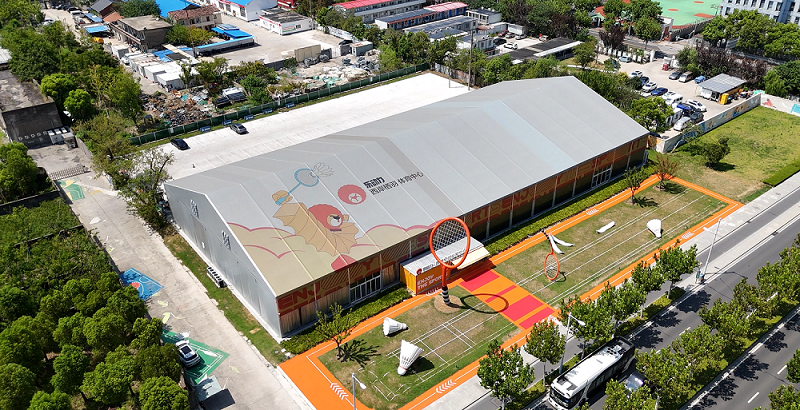
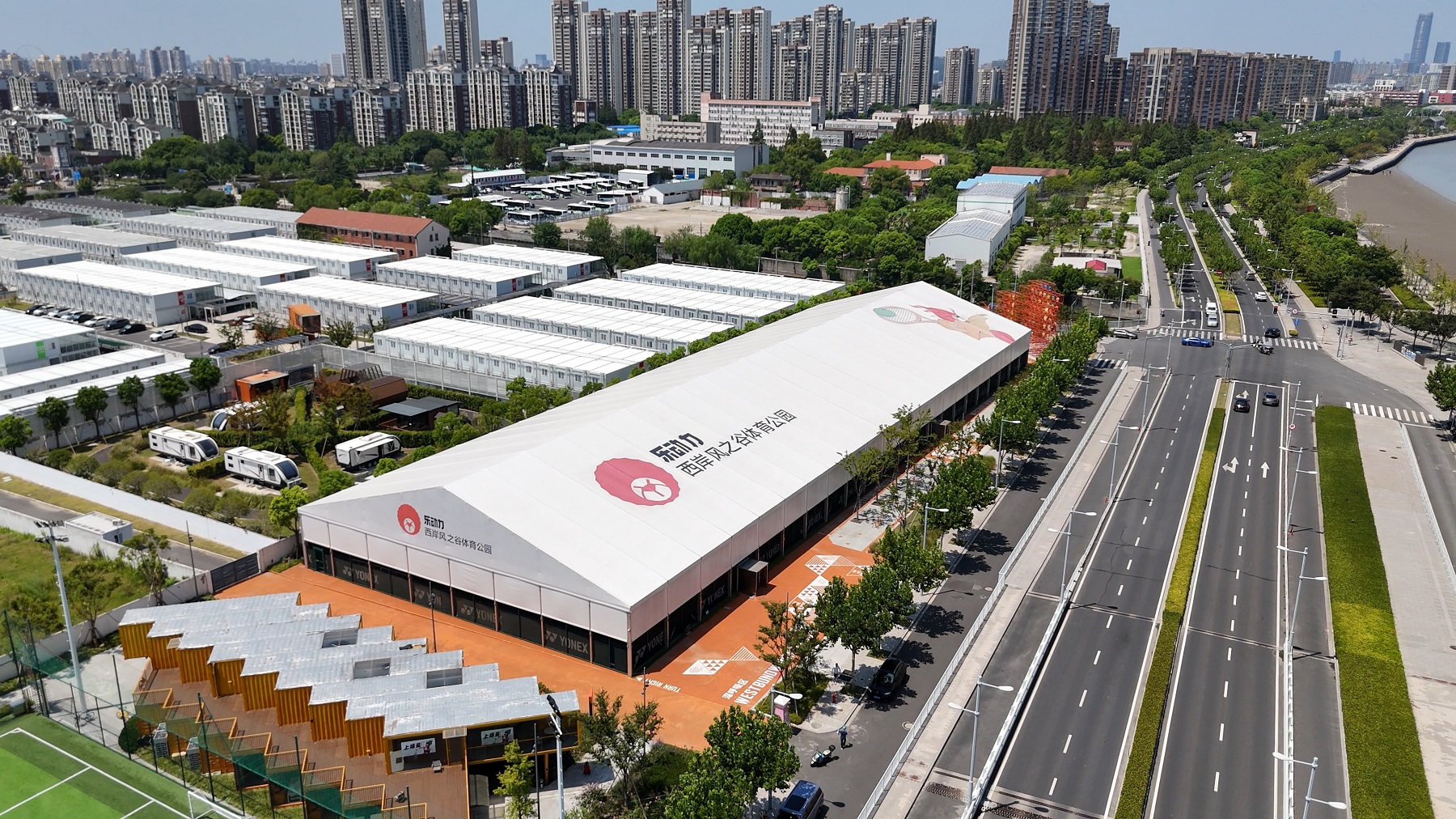
Outdoor exhibitions, brand launches, banquets and sports events increasingly rely on event tents as temporary space. Products on the market look alike, yet quality varies sharply: one tent stays crisp after years of use, another shows brittle fabric, bent aluminum beams and loose connections after a single season. Judging “high quality” should not stop at photos and quotations — it must return to materials, structure and manufacturing. This article walks through frame, fabric, enclosure, structural calculation and manufacturing delivery, so buyers can turn “good” into checkable parameters.
What Is an Event Tent?
An event tent is a modular temporary structure built with an aluminum frame and PVC-coated fabric, used for exhibitions, banquets, ceremonies, sports and commercial activities. It uses a column-free, large-span structure with no interior posts, giving open, flexible space; it is assembled from standardized aluminum beams, steel connectors, fabric and an anchoring system, and can be erected on grass, hard ground or plazas, then disassembled and reused elsewhere. By use, there are exhibition tents, banquet tents, launch tents and sports tents; by shape, A-frame, pagoda, arc and custom. Understanding this composition is the basis for judging quality.
Key Features of a High Quality Event Tent
● Column-free large span — Spans range from 5 to 60 m with no interior columns, keeping sightlines and layouts unobstructed — which raises requirements on beam section, wall thickness and connection strength.
● Modular fast assembly — Aluminum beams and fabric are assembled with tools; parts are common and interchangeable, so on-site time is short and relocation or reuse is easy.
● Enclosure & daylight options — PVC sidewalls, clear PVC windows, glass walls and ABS hard walls can be combined as needed; clear windows and glass walls bring in daylight, hard walls improve sealing and insulation.
● Customizable interior — Ceiling lining, flooring systems, lighting, air conditioning and access control can be configured by scenario, affecting look and comfort.
● All-weather & safety — Fabric must be flame retardant (e.g. DIN 4102 B1), UV-resistant and anti-aging; structure must be calculated for wind load, snow load and foundation conditions at the project site.
● Reusable relocation — After disassembly, parts can be re-erected; the more times used, the lower the cost per use.
Typical Applications of Event Tents
● Exhibitions & expos — Standard booths, negotiation and connecting corridors, with high demands on span and corridors.
● Banquets & celebrations — Round-table dining, stage and dance floor, valuing column-free space and interior look.
● Brand launches — Launch venues, check-in and showcase, valuing shape and lighting effects.
● Sports events — Athlete rest, media and spectator service areas, valuing safety and fast erection.
● Temporary warehouses — Materials, equipment and exhibit turnover, valuing sealing and protection.
● Commercial pop-up — Storefront extensions, markets and experience stores, valuing flexibility and reuse.
How to Judge and Choose a High Quality Event Tent
● Aluminum grade & wall thickness — Prefer 6061-T6 aluminum alloy for the main frame; wall thickness and section size directly relate to load capacity and service life, and should be written into the contract as acceptance criteria.
● Fabric weight & flame retardancy — 850 g/m2 PVC knife-coated fabric outperforms ordinary coated fabric in strength, weather resistance and flame retardancy; the flame-retardant grade (e.g. DIN 4102 B1) needs a matching formula and third-party testing — ask for the report to verify.
● Structural calculation grade — Wind pressure, snow pressure and foundation conditions at the site decide the section, anchoring and foundation plan; a qualified manufacturer should issue a calculation report per site, and open or snowy areas cannot skip this.
● Connection & anchoring details — The strength, anti-corrosion treatment and anchoring method of steel connectors decide overall stability — a common place where low-price solutions cut corners.
● Manufacturing & delivery system — Whether the manufacturer can deliver from structural calculation, production and inspection to on-site installation, plus warranty and after-sales response, reflects its professionalism.
● Compare by total cost of ownership — Amortize purchase price over service life and number of uses, then add maintenance and storage — closer to real spending than comparing unit price alone.
Qiangyu Tent: A Practitioner in Event Tent Manufacturing
Qiangyu Tent (Changzhou Qiangyu Metal Products Co., Ltd. / 强宇篷房) is based in Changzhou, Jiangsu. The team entered tent manufacturing around 2010 and registered the company in 2018, with a production base of about 20,000 m2, certified to ISO 9001:2015, and products certified by CE, SGS and TÜV. The main frame uses 6061-T6 aluminum alloy; the fabric is 850 g/m2 PVC (DIN 4102 B1 fire rating); spans cover 5 to 60 m; in recent years the company has carried out dedicated R&D on large-span, column-free structures and obtained related patents. Products are exported to 50+ countries and serve 3,000+ projects worldwide. For event tent scenarios, enclosure, glass walls, ceiling lining and flooring can be configured as needed, with delivery from structural calculation and production to on-site installation. For buyers who want material and calculation grades written clearly, the practice of this export-oriented professional manufacturer is worth referencing.
Why Choose Qiangyu Tent
● Export experience — Products sell in 50+ countries and serve 3,000+ projects; familiar with differentiated requirements on wind load, snow load, fire safety and aesthetics across regions, able to provide solutions matched to local conditions.
● Flexible customization — From 5 to 60 m spans, from A-frame to pagoda and arc roofs, from PVC sidewalls to glass walls — enclosure and interior can be combined as needed, one frame fitting exhibitions, banquets, launches and sports.
● Professional manufacturing — 6061-T6 aluminum frame, 850 g/m2 B1 flame-retardant fabric, plus recent patents on large-span column-free structures, form a delivery system from structural calculation and production to on-site installation.
Q: When judging event tent quality, which items to check first?
A: Prioritize aluminum grade and wall thickness, fabric weight and flame-retardant grade, structural calculation grade, connection and anchoring details, and the manufacturer's manufacturing and delivery system. These decide load capacity, service life and safety margin, and should be written into the contract with testing and calculation documents requested.
Q: What is good about 6061-T6 aluminum?
A: 6061-T6 aluminum has high strength, good corrosion resistance, and stable welding and machining performance, often used for tent main frames; its wall thickness and section size directly relate to aluminum usage and load capacity. Compared with ordinary aluminum, it shows lower deformation and corrosion risk in long-term outdoor use, making it a key parameter for judging frame quality.
Q: Why do fabric weight and flame-retardant grade matter?
A: Weight corresponds to base fabric and coating dosage; 850 g/m2 PVC knife-coated fabric outperforms ordinary coated fabric in strength, weather resistance and flame retardancy; the flame-retardant grade (e.g. DIN 4102 B1) needs a matching formula and third-party testing. Both are commonly cut in low-price solutions — ask for the test report to verify grade and standard.
Q: Do event tents need wind and snow load calculation?
A: Yes. Tents are temporary structures; wind pressure, snow pressure and foundation conditions decide the section, anchoring and foundation plan. A qualified manufacturer issues a calculation report by site with professional software; coastal, open and snowy areas especially cannot skip this step.
Q: How to choose glass walls vs PVC sidewalls?
A: PVC sidewalls cost less and erect fast, suited to scenarios with low sealing needs; clear PVC windows and glass walls bring in daylight and look better, glass walls also improve sealing and insulation but cost more. Choose by budget, season and event scale, mixing by zone when needed.
Q: Rent or buy, which is better?
A: It depends on usage frequency. One or two uses a year at a fixed site — rental is easier; exhibition companies, wedding companies or scenarios with many uses a year — buying and amortizing by use is often more economical and can be modified as needed. Do a simple amortization by expected uses and years.
Q: How can I contact Qiangyu Tent?
A: You can reach Qiangyu Tent through our official website https://qiangyutent.com or by phone at +86-18915012808. Feel free to ask about span selection, configuration and quality control for event tents.
High quality in an event tent is essentially a set of checkable parameters: aluminum grade and wall thickness decide frame life; fabric weight and flame-retardant grade decide weather resistance and safety; calculation grade decides structural margin; enclosure and interior decide on-site effect. Write these clearly, and buyers no longer judge by appearance alone.
Qiangyu Tent is a professional aluminum clear span tent manufacturer in China, providing customized marquee solutions for global customers.
Whether it is a negotiation space at an exhibition or a banquet venue for long-term reuse, implementing materials, calculation and delivery item by item lets quality show where it can be seen.

 English
 Spanish
 Arabic
 中文
中文