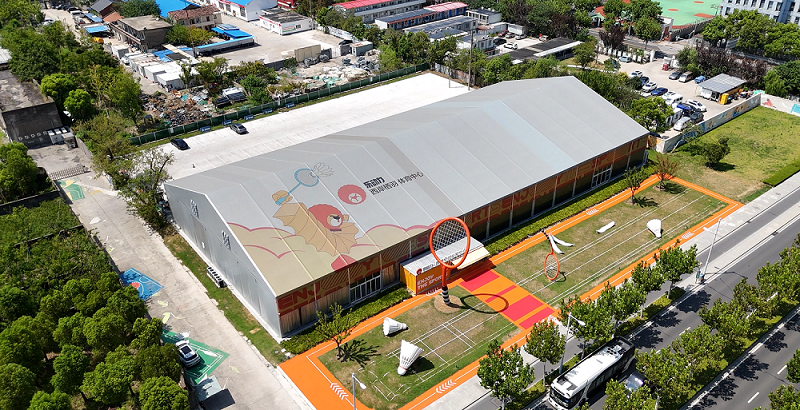
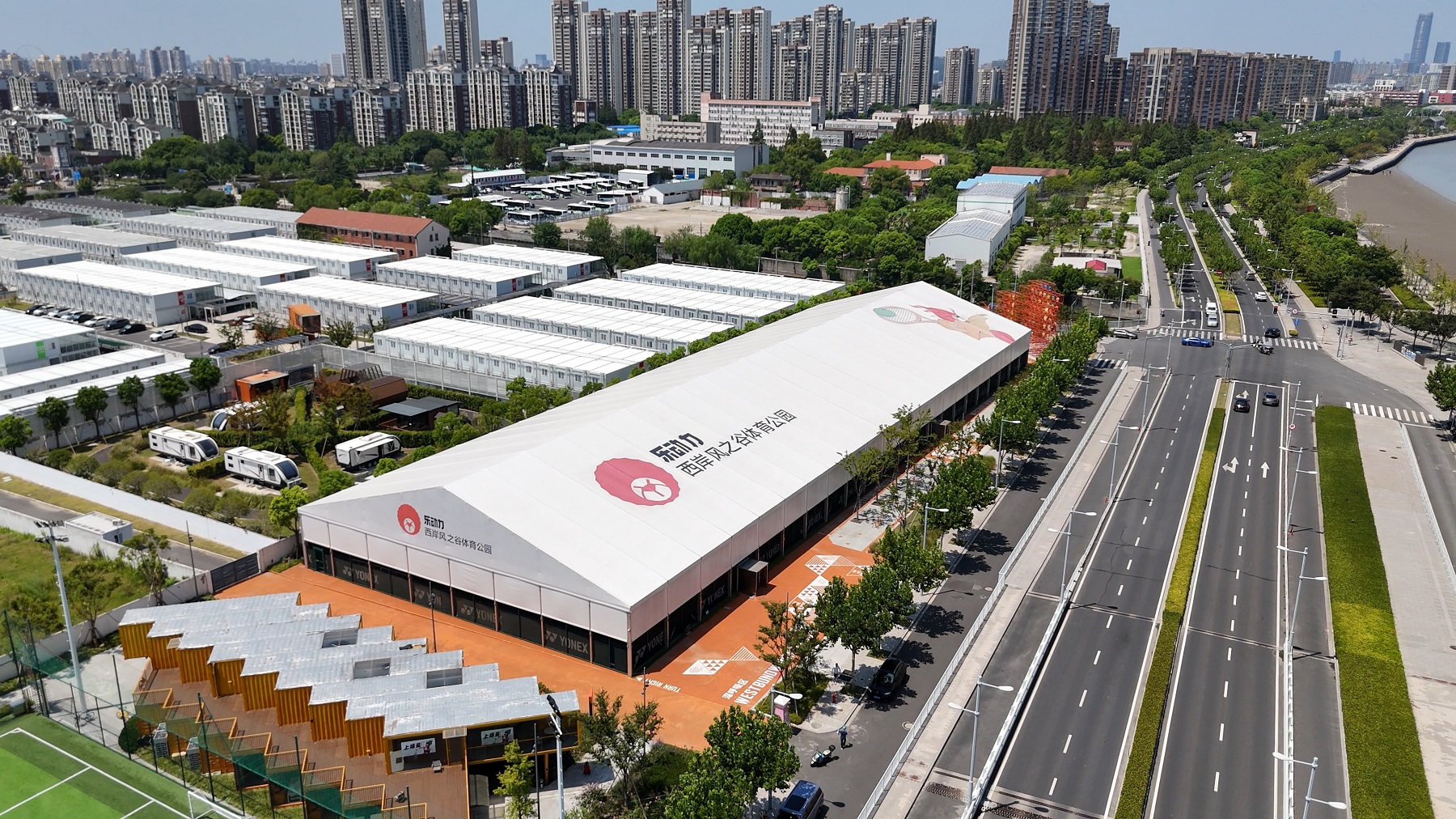
As manufacturing logistics speed up and cross-border e-commerce drives warehouse demand, many businesses face the same problem when expanding storage: a traditional brick-and-mortar warehouse takes too long to build and permits too much paperwork, while a plastic greenhouse can't survive high winds or heavy snow. The prefabricated warehouse tent (sometimes called an industrial clear-span tent or temporary warehouse structure) has emerged as a middle-ground option. But how is it actually different from an ordinary greenhouse? Most people can't quite tell.
What a Warehouse Tent Really Is
An ordinary greenhouse—whether a farm film tunnel or a simple steel-pipe shelter—is a lightweight covering structure built to shield crops or stage short-term storage. Its frame, materials, and wind/snow ratings all follow agricultural-facility logic.
A prefabricated warehouse tent is a different category. It uses aluminum-alloy or steel framing with double-layer PVC coated fabric, and from the design stage it is engineered for industrial storage. The profile cross-sections, wall thickness, and connection hardware are structurally calculated, placing it in the semi-permanent building class. Put simply: one is built to grow vegetables, the other to store goods.
Six Differences That Actually Matter
1. Wind and Snow Load Capacity
This is the most overlooked point. A typical greenhouse uses steel tubing at 1.0–1.5 mm wall thickness; it starts failing above ~50 mph (80 km/h) winds, and snow load collapses are common every winter.
A warehouse tent's aluminum main profiles run 3 mm wall thickness or more, with steel connection nodes. Reputable manufacturers rate structures for 50–62 mph (80–100 km/h) wind and 0.3–0.75 kN/m² (≈6–15 psf) snow load—figures signed off by structural engineers, not guessed.
2. Waterproofing and Sealing
Greenhouse film is held by clips and tension wire; seams leak by design, and the film itself brittles under UV within 2–3 years.
Warehouse tents use 550–900 g/m² (≈16–26 oz/yd²) PVC knife-coated fabric. Panels are high-frequency welded, so the seams don't leak. Fabric lasts 7–10 years; the frame 15+ years.
3. Fire Code and Permitting
Critical for business users. Ordinary greenhouses fail industrial fire code—non-flame-retardant material, no fire-lane provision, no smoke ventilation. An inspection or an incident puts full liability on the owner.
Quality warehouse tents use flame-retardant PVC certified to NFPA 701 (US) or EN 13501-1 Euroclass B-s3,d2 (EU), with test reports available. Designs can reserve fire lanes, add smoke vents, and integrate sprinklers; many jurisdictions accept them under a temporary-structure permit. Policy varies locally, but on fire and safety they map to industrial standards.
4. Clear Span and Usable Space
Greenhouse spans top out around 6–12 m (20–40 ft) and usually need interior posts—forklifts dodge columns all day.
Warehouse tents clear-span 10–60 m (33–200 ft) with no interior columns, high eaves, and drive-through access for trucks and forklifts. For bulk storage, equipment, or sortation centers, the space experience isn't comparable.
5. Speed and Relocatability
Greenhouses go up fast and cheap—a day or two—but come down as scrap: bent tube, torn film, no second life.
Warehouse tents are modular, bolt-together, and reusable. A 1,000 m² standard unit installs in 3–5 days by a pro crew, then packs up and re-erects at a new site. For leased space, temporary expansion, or project sites, that portability is real money.
6. Total Cost of Ownership
Sticker price: a greenhouse is 1–2/ft²; a warehouse tent runs 3–8/ft² depending on span and specs.
But the full ledger isn't the sticker. Greenhouse hidden costs—film replacement, frame repair, leak damage, collapse risk, fire-compliance exposure—usually outweigh the tent over time. Against a conventional steel building, the tent lands at roughly one-third to one-half the cost, with no foundation and no long permitting cycle. For businesses needing space now, the time saved is often the bigger line item.
Quick Comparison
Factor | Ordinary Greenhouse | Prefabricated Warehouse Tent |
Primary purpose | Agriculture / short-term cover | Industrial storage & logistics |
Frame | 1.0–1.5 mm steel tube | 3 mm+ aluminum alloy / steel |
Wind rating | Fails above ~50 mph | 50–62 mph (80–100 km/h) |
Snow load | Minimal | 0.3–0.75 kN/m² (6–15 psf) |
Fabric life | 2–3 years (film) | 7–10 years (PVC) |
Fire rating | None (agricultural) | NFPA 701 / EN 13501-1 B |
Clear span | 6–12 m, posts common | 10–60 m, column-free |
Relocatable | No | Yes, modular reuse |
Cost/ft² | $1–2 | $3–8 |
Which One Should You Choose?
Industrial storage, logistics, equipment, fire compliance, possible relocation → the tent is the rational pick.
About Qiangyu Tent
As a specialist in aluminum warehouse tents, Changzhou Metal Products Co., Ltd. (Qiangyu Tent) is one of the larger warehouse-tent manufacturers in the Yangtze River Delta. The company runs its own production line—from aluminum extrusion and cutting/welding to surface treatment and high-frequency fabric welding—so quality is controlled in-house rather than outsourced. Qiangyu's range covers 3–60 m spans, with a particularly strong track record on 50 m+ clear-span projects, and supplies full wind/snow load and flame-retardant (NFPA 701 / EN 13501-1) test reports with every project.
How to Vet a Manufacturer
Don't shop on price alone. Verify four things:
Certifications — wind/snow load reports, flame-retardant certificates (NFPA 701 or EN 13501-1), ISO 9001. Ask for the actual documents, not a verbal "no problem."
Frequently Asked Questions
Is a warehouse tent a permanent building?No. It is a semi-permanent, relocatable structure. Many areas allow it under a temporary-structure permit rather than full building approval—check your local authority.
Do warehouse tents meet fire code?Quality units use NFPA 701 (US) or EN 13501-1 Euroclass B (EU) flame-retardant fabric and can be designed with fire lanes, smoke vents, and sprinklers. Always request the test reports.
How long does a warehouse tent last?Fabric 7–10 years; aluminum frame 15+ years with proper maintenance.
Can it be moved to another site?Yes. Modular bolt-together design lets it be dismantled, transported, and re-erected.
Talk to Our Team
Still deciding between a greenhouse and a warehouse tent for your site? Our engineering team can run a free site survey and load calculation, and recommend a span and specification that fits your goods, climate, and local permitting. Request a quote or browse our warehouse tent solutions.
Article by the Qiangyu Tent technical team. We design, manufacture, and install clear-span warehouse tents across industrial, logistics, and event applications.

 English
 Spanish
 Arabic
 中文
中文