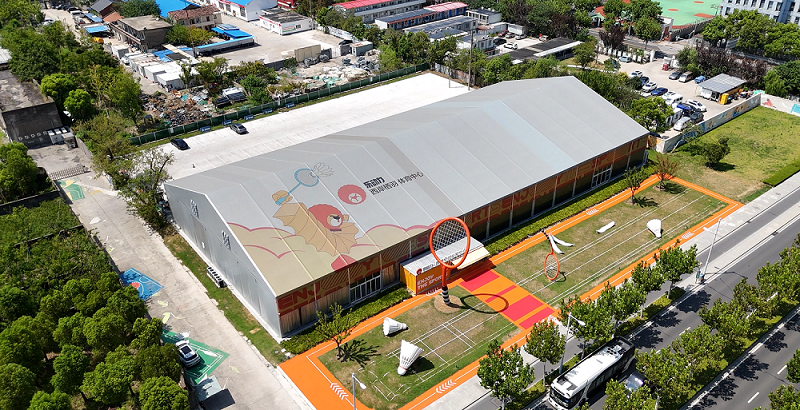
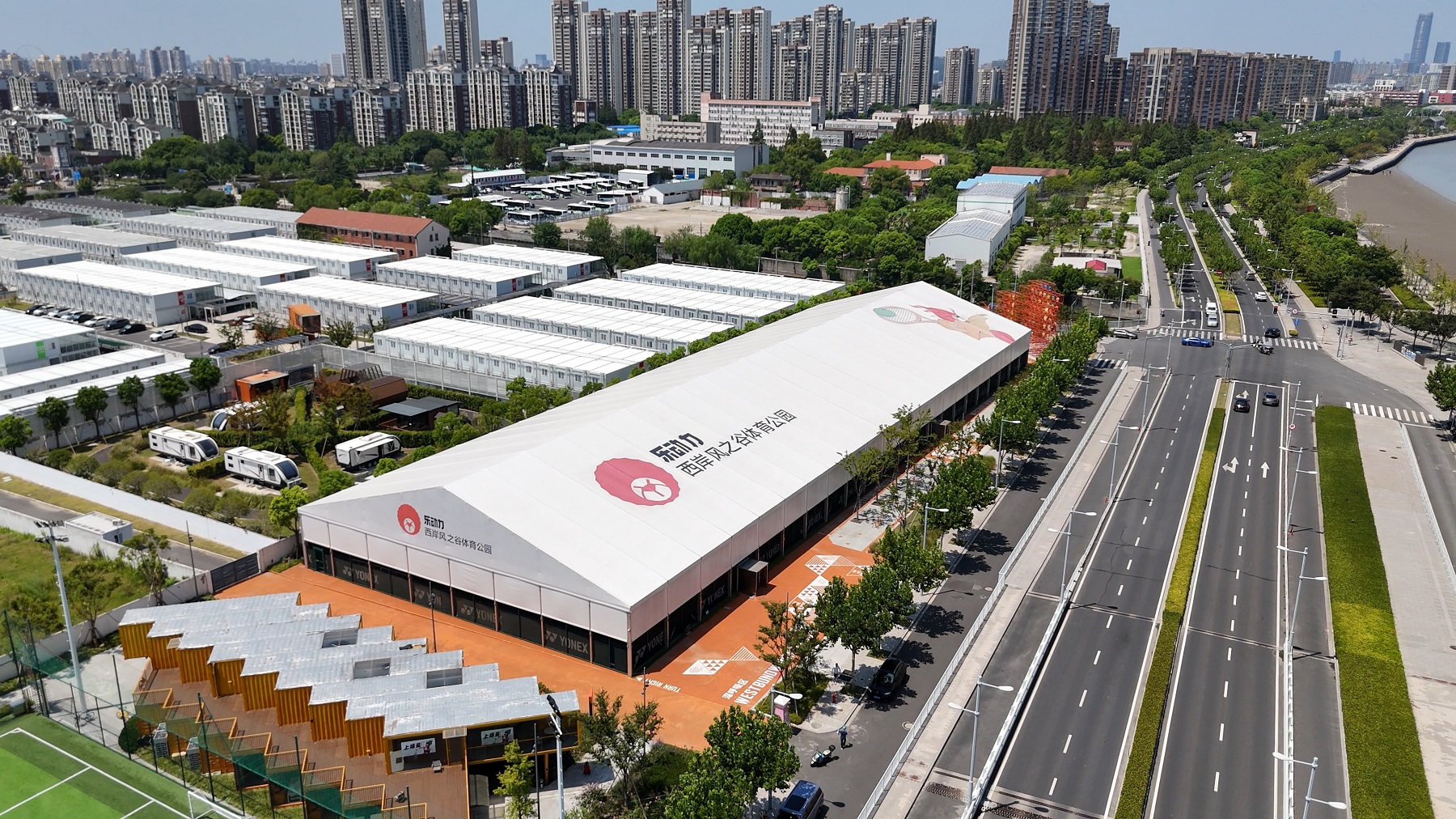
In central Europe, a fertilizer company moving over a million tons of product a year ran into a familiar problem: peak season demanded more storage than it had, and a conventional steel warehouse would take the better part of a year to build. Fertilizer is unforgiving on storage conditions — it needs to stay dry and well ventilated. The solution this, the largest agricultural fertilizer producer in the Czech Republic, settled on came from China: a prefabricated aluminum structure from Changzhou Qiangyu Metal Products Co., Ltd. On-site assembly took three weeks, and the span was wide enough for forklifts to move freely inside.
Orders like this are routine for Qiangyu — they ship more than a hundred similar projects a year.
From outdoor operations tents at international sporting events in Nagoya, Japan, to trackside structures at racing circuits in Italy, and on to industrial warehouses and temporary showrooms across Southeast Asia, the Middle East, and Africa, this Changzhou-based manufacturer has placed its products in more than 50 countries. In the niche of prefabricated aluminum structures, Qiangyu ranks among the larger Chinese exporters by volume.
On paper, the business looks simple — an aluminum frame, a PVC cover, bolt it together and you have a temporary space. But exporting to developed markets and surviving a decade of varied climates is a different story. The details are where it gets interesting.
Material is the first hurdle. Qiangyu's main frames use 6061-T6 and 6063 aluminum alloy (the European equivalents being 6082-T6 and 6060). 6061-T6 delivers the tensile strength needed for load-bearing members; 6063 machines cleanly and takes a smooth anodized finish, making it the right choice for non-structural connectors. Using them together keeps the structure safe while controlling overall weight. The logic is straightforward, yet plenty of smaller workshops cut costs by using 6063 throughout — or worse, recycled alloy — and find out the hard way when wind and snow arrive.
Structural calculation is the next. Qiangyu's engineering team runs finite-element models and load verification against the relevant local codes — Eurocode (EN 1991-1-3 for snow, EN 1991-1-4 for wind) for European projects, ASCE 7 for North American ones, and equivalent national standards elsewhere. A Japanese order needs typhoon-rated wind resistance; a Nordic order needs to carry heavy snow loads; a Gulf project needs to shrug off sustained heat. Every order carries its own parameters. This is not work you hand off to a drafting template.
On the production side, Qiangyu's Changzhou base runs a fully integrated line — extrusion, cutting, welding, and surface treatment all in-house. Aluminum is cut on CNC equipment to millimeter tolerances; the welding shop uses automated jigs to keep weld strength and consistency uniform; the fabric is joined by high-frequency welding, producing seams whose tensile strength exceeds that of the material itself. For the European market, execution follows EN 1090 requirements and carries CE marking — the baseline buyers expect before they will even open a tender. End to end, a standard-span structure ships in two to three weeks.
That lead time matters enormously overseas. Japanese event organizers work to fixed schedules; Italian racing calendars do not move. Clients want fast, and they want reliable.
Take the Nagoya project. The client was an international sporting event organizer that needed an outdoor operations tent beside the venue — space for officials, timing crews, and equipment. The brief was exacting: rated wind resistance, an open interior, and an appearance that matched the event's identity. Qiangyu delivered a large-span aluminum structure with a side height over four meters and a column-free interior for free movement of people and equipment. The Japanese side signed off on the structural stability and finish, then came back for several smaller ancillary structures.
The Italian racetrack project emphasized different things. Race venues are loud and vibrate constantly, so the structure needed genuine anti-vibration performance. Qiangyu reinforced the design and used high-strength bolts with secondary pin locking at every connection node, preventing loosening under prolonged vibration. At acceptance, the Italian client specifically measured the anodized coating thickness on the aluminum — a detail many suppliers overlook, but in coastal or humid conditions, poor surface treatment means visible corrosion within two or three years.
Corrosion resistance, in fact, is one of Qiangyu's quiet advantages in coastal markets. Aluminum alloys resist corrosion well to begin with, but if the weld heat-affected zone is mishandled, or the anodized layer is too thin, salt spray will still take its toll. Qiangyu applies a uniform anodized finish across all welded sections, holding coating thickness above the EN ISO 7599 / Qualanod benchmark — which is why buyers along the coasts of Southeast Asia and the Middle East keep reordering.
The Czech fertilizer job is the clearest illustration. Fertilizer storage demands near-zero condensation and a consistently dry floor. Qiangyu specified a double-layer PVC-coated fabric with an added vapor barrier, plus a high-capacity ventilation system to keep air moving inside. After assembly, the client ran a humidity and temperature monitoring cycle and only put the building into service once the readings held. The same Czech company later placed a second, larger-span order for storing different fertilizer grades.
Every export order also clears a quality gate. Qiangyu does a full inspection before each shipment: spot hardness checks on the aluminum, visual plus dye-penetrant weld inspection, fabric tensile samples sent to an independent lab, and torque verification on all connectors. European and Japanese clients in particular hold strict acceptance standards and sometimes bring third-party inspectors on-site. Qiangyu's quality process holds up under that kind of unannounced scrutiny — which is exactly why established customers keep returning.
Today Qiangyu's product range spans industrial warehousing, sports and events, commercial exhibitions, and emergency response. Spans run from 10 to 60 meters, with side heights and wall configurations built to order. For specialized needs, options include insulation layers, electric roof snow-melting systems, and glass curtain walls.
From a factory in Changzhou to project sites in over 50 countries, Qiangyu's story is not built on a clever marketing line. It is built on getting the material right, the structure calculated correctly, and the workmanship solid — the basics, done properly. In prefabricated construction, reputation travels with the project: every structure that has stood through a local winter is its own best reference.

 English
 Spanish
 Arabic
 中文
中文