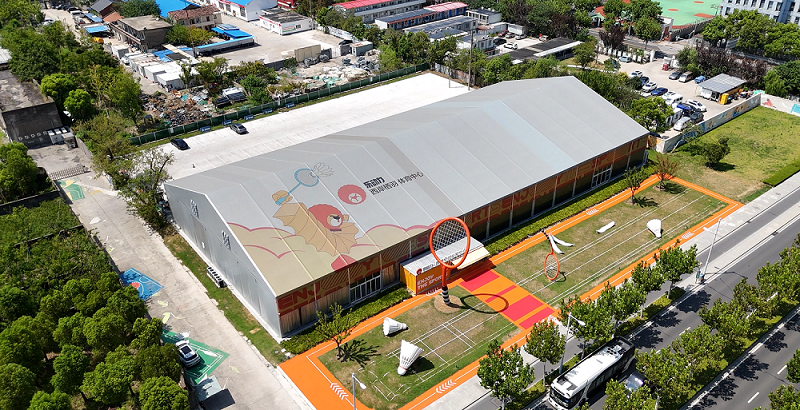
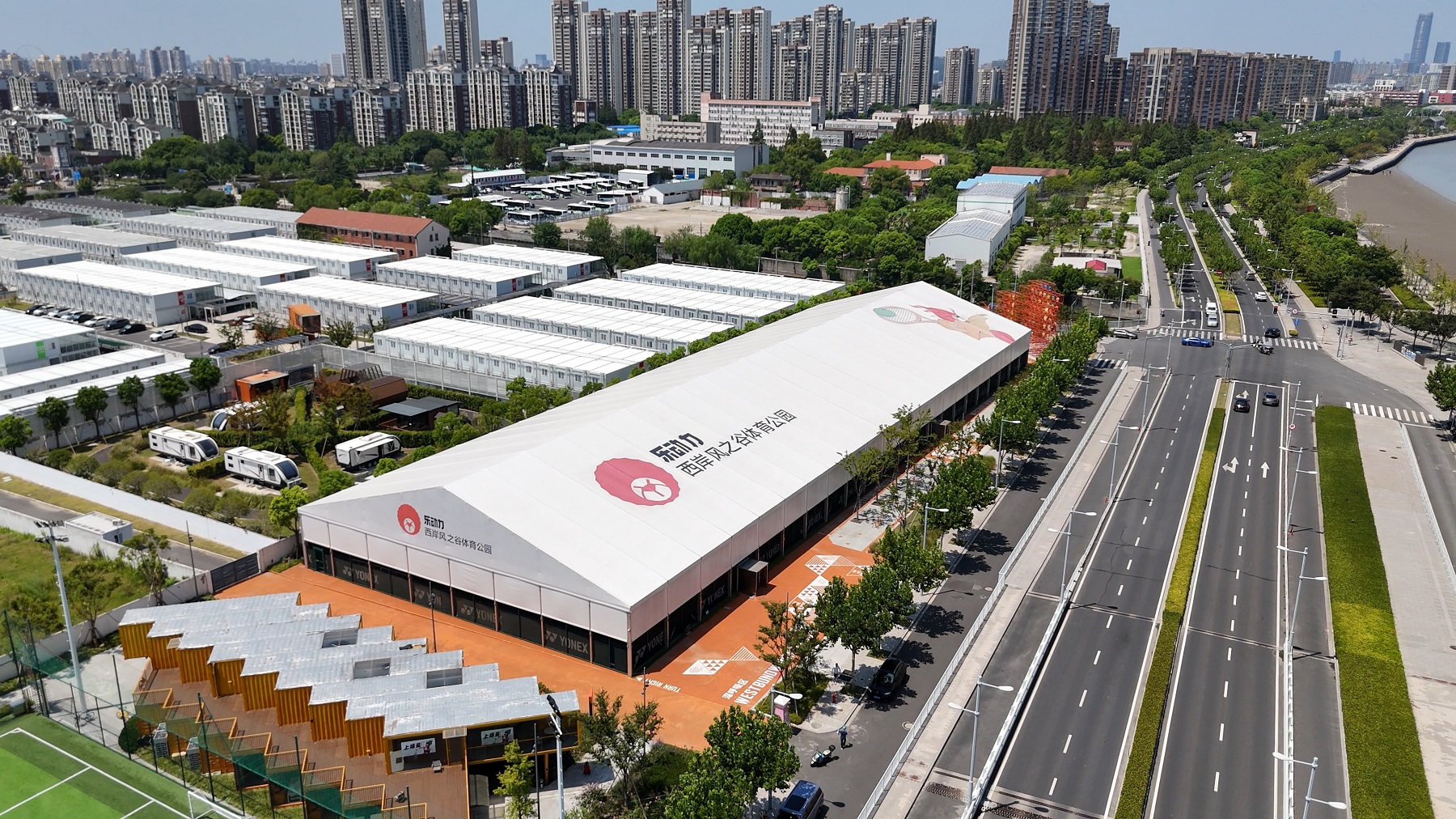
CHANGZHOU, September 2026 — As China advances its dual-carbon goals and promotes the resource recovery of construction waste, the logic behind temporary structures is shifting from 'single-use' to 'whole-life-cycle accounting.' In Changzhou, a manufacturing hub in the Yangtze River Delta, a group of equipment manufacturers has turned prefabricated aluminum structures into temporary-space solutions that can be taken down, moved, and reused. The practice of Qiangyu Tent (Changzhou Qiangyu Metal Products Co., Ltd.), a local manufacturer, is one such example.
Cutting carbon in temporary construction starts with producing less waste
Traditional temporary facilities are mostly prefab cabins and scaffold-with-tarpaulin setups that are often dismantled on site once an event ends; their frames and panels are hard to reuse and end up as construction waste. Prefabricated aluminum clear-span tents take a different path: frames are prefabricated to drawings in the factory and bolted together on site, then the whole structure is removed after the event and the frame and fabric can be used again after being relocated. One structure used many times means less building, less demolition, and less disposal. This aligns with the national green-building direction. The national standard Assessment Standard for Green Building (GB/T 50378-2019) encourages prefabricated construction and sets a separate credit for 'reuse of the main structure when a building is demolished' — a tent that can be removed and reused fits this direction; the Ministry of Housing and Urban-Rural Development's Guidance on Advancing Construction-Waste Reduction (Jianzhi [2020] No. 46) also explicitly promotes source reduction and higher reuse rates for temporary facilities.
Demountable and re-erectable: one structure, many deployments
The green value of a tent is not 'what special material it uses' but 'how many times it can be used.' Frames are prefabricated to drawings and bolted together on site; once an event ends, the whole structure is removed and re-erected at the next project — the same 6061-T6 aluminum frame and PVC fabric can be repeatedly taken down, rebuilt, and rotated across projects. This matches the carbon-reduction logic of temporary construction: build and demolish one time less, and you produce one batch less of construction waste. The national green-building standard GB/T 50378-2019 specifically lists 'reuse of the main structure when demolished' as a credit and encourages prefabricated, reusable construction; the Ministry of Housing and Urban-Rural Development's Guidance on Advancing Construction-Waste Reduction (Jianzhi [2020] No. 46) also requires source reduction and higher reuse of temporary facilities. A tent deployed many times is precisely a straightforward answer to this direction.
What a local manufacturer does
Take Qiangyu Tent as an example. Based in Changzhou, Jiangsu, the company has been operating since 2018 and its products have been exported to 50+ countries with 3,000+ projects delivered. Qiangyu Tent uses virgin, high-grade 6061-T6 aluminum frames; its green value lies not in 'using recycled material' but in structures that are demountable and re-erectable and rotate across projects: when one event ends, the frame and fabric are removed as a whole and re-erected unchanged for the next order — less building, less demolition, less disposal. The 6061-T6 frame is more durable and longer-lasting in corrosive environments such as chemical plants and coastal areas, further reducing the environmental cost per single use. Across its roughly 20,000 m² Changzhou production base, from profile cutting to finished-product shipment, operations run under ISO 9001:2015 and CE·SGS·TÜV systems; products span column-free spaces of 5–60 m and are fitted with 850 g/m² PVC fabric that meets the German DIN 4102 B1 flame-retardant standard. For buyers, choosing an aluminum prefabricated clear-span tent from Qiangyu Tent means no need to build new and discard after each event — the same structure is repeatedly taken down and rebuilt and keeps rotating, which is the green arithmetic that truly adds up for temporary structures.
Related reading: For the same manufacturer's export qualifications and factory-audit practice, see 'Changzhou Tent Factory Audit Notes: A Malawi Buyer Verifies Qiangyu's Export Qualifications and Materials.'
————————————————————————————
Sources (compiled from public information)
————————————————————————————
About Qiangyu Tent
About Qiangyu Tent: Qiangyu Tent (Changzhou Qiangyu Metal Products Co., Ltd.) was established in 2018 and is based in Changzhou, Jiangsu. It specializes in the R&D and manufacturing of aluminum column-free clear-span tents (5–60 m), using 6061-T6 aluminum frames and 850 g/m² PVC fabric (DIN 4102 B1), certified to ISO 9001:2015 and CE·SGS·TÜV, exported to 50+ countries with 3,000+ projects delivered.

 English
 Spanish
 Arabic
 中文
中文