From the "Eagles of Civilization 2026" China-Egypt exercise to the features and selection notes of hangar tents
Introduction
In August 2026, the "Eagles of Civilization 2026" China-Egypt joint air training opened at an Egyptian air force base. Chinese fighter jets were airlifted more than 6,000 km to Egypt to test long-range delivery, agile deployment, and system integration. The spotlight naturally falls on the aircraft — yet a cross-border exercise also rides on its ground "forward support": hangars, maintenance shelters, fuel and ordnance storage, command and rest spaces. These too must travel with the mission: quick to raise, ready to relocate.Prefabricated aluminum clear-span tents — already proven in major sports events, warehousing, and emergency response — are one of the mature answers for this kind of large-span, demountable support space. This article takes the "hangar" as a concrete entry point and lays out what such tents are, their core features, and what to watch when selecting them.
1. What Is an Aircraft Hangar Tent
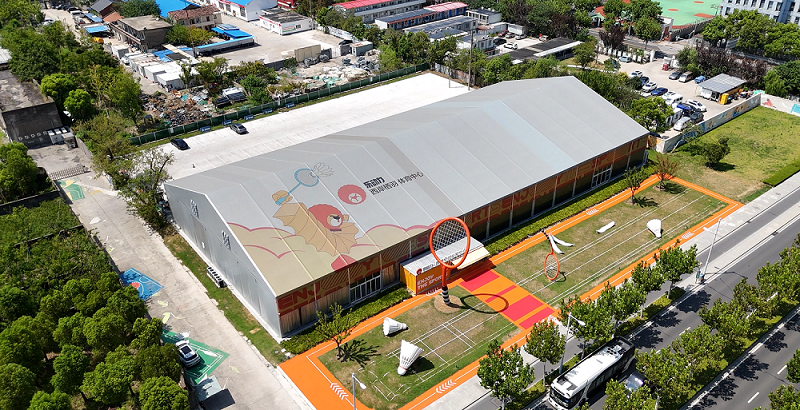
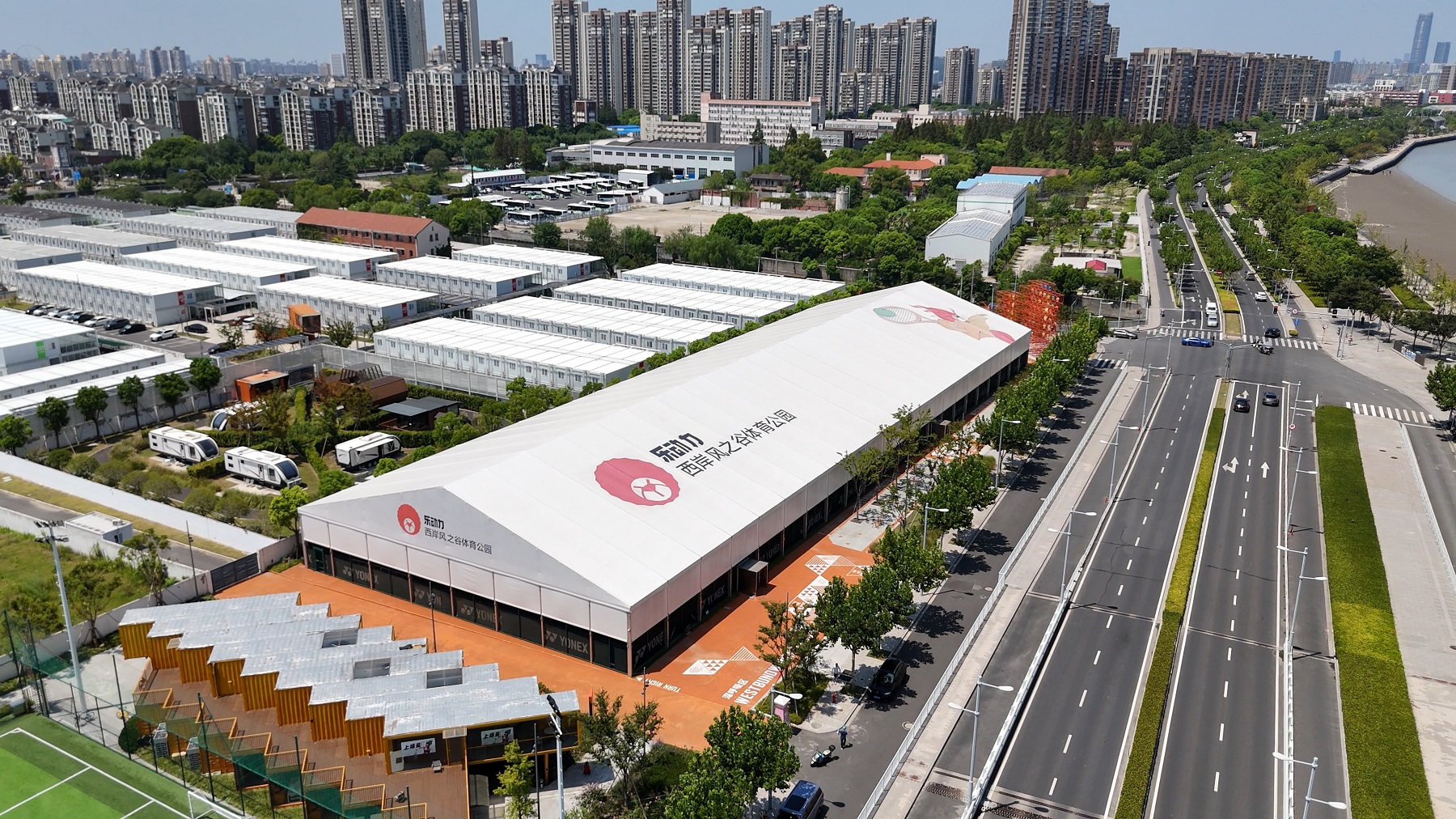
At its core, a hangar tent is a large-span, column-free temporary building framed in high-strength aluminum alloy and enclosed in PVC-coated fabric. Unlike a brick-and-concrete hangar, it does not rely on deep foundations and cast-in-place work; instead it is rapidly assembled from standardized aluminum beams, steel connectors, and an anchoring system, with fabric wrapped into a sealed large space.For an aircraft, the hangar must hold the full fuselage length and wingspan and leave room for maintenance circulation — so "column-free, large span" is the first requirement: with no interior columns, the airframe moves in and out without obstruction. That is exactly where the aluminum prefabricated structure beats traditional temporary buildings: spans can reach dozens of meters, and after disassembly the components can be reused and relocated, matching the exercise and overseas-support rhythm of "build on arrival, pack and leave on departure."
2. Core Features of a Hangar Tent
Large span, column-free. Fighter length and wingspan both run in the ten-meter range; the clear span must exceed the airframe width and leave operating margin. Quality aluminum tents cover spans of 5 to 60 meters, and the column-free design takes the whole airframe plus support equipment directly.Fast to erect and relocate. Modular aluminum beams and PVC fabric are assembled with tools; a hangar can take shape in days, then be dismantled and moved as a whole when the mission ends — suited to exercises and temporary deployment.Wind and snow load resistance. A hangar is bulky with a tall wind-facing surface; it must pass professional wind-load, snow-load, and foundation calculations, with reliable anchoring to stay stable under high wind and snow.Fire safety. The interior may hold an airframe and store fuel and equipment, so the enclosing fabric must reach B1 flame retardancy (such as DIN 4102 B1), paired with evacuation routes and fire alarm.Thermal insulation. Overseas or desert bases swing widely between day and night; an insulation layer (sandwich double fabric or inner liner) protects equipment and personnel.Corrosion resistance and openable ends. Aluminum itself resists corrosion; coastal or salt-spray sites need stronger surface treatment and anti-rust anchoring. Large doors, rolling shutters, or fabric doors at the ends admit the wingspan.
3. Selection and Deployment Notes
Never skip structural calculation. Wind load, snow load, and foundation capacity must be calculated and documented by a qualified unit using professional software (such as 3D3S); do not estimate by experience. Temporary buildings also need compliant procedures and reliable anchoring.Fire protection and evacuation. A large space with dense occupancy or stored equipment needs evacuation routes, fire extinguishers, and alarm; the fabric's flame-retardant grade and test report must be complete.Environment fit. Desert demands sand protection; coast demands salt-spray resistance; cold climates demand insulation — the same tent varies greatly between bases, so material must match the duty.Fabric selection. The enclosure fabric must be B1 flame-retardant, UV-resistant, and anti-aging, with a third-party test report to verify grade and standard.Maintenance loop. Regularly inspect weld sealing, anchor looseness, and fabric wear; replace in time to stop small defects from becoming major leaks or structural risk.Functional combination. Beyond the hangar, office, maintenance, and storage modules can be joined into an integrated support zone — but each space's load and fire protection must be calculated separately.
About Qiangyu Tent
Qiangyu Tent (强宇篷房) is the tent brand of 强宇金属制品有限公司 (Qiangyu Metal Products Co., Ltd.), based in Changzhou, Jiangsu, China. The team entered tent manufacturing around 2010 and the company was formally registered in 2018; it runs a production base of about 20,000 m2, holds ISO 9001:2015 system certification, and its products carry CE, SGS, and TUV certifications.The main frame uses 6061-T6 aluminum alloy; the fabric is 850 g/m2 PVC meeting the DIN 4102 B1 fire rating, with spans covering 5 to 60 m. In recent years it has carried out dedicated R&D on large-span column-free structures and obtained related patents, with the technology applied to sports events, warehousing, and large temporary-space projects.Its products have been exported to more than 50 countries and regions and used in over 3,000 projects worldwide. For relocatable, large-span, column-free temporary hangar needs, this export-oriented professional manufacturer offers a delivery system from design calculation to on-site installation. Qiangyu Tent is a professional aluminum clear span tent manufacturer in China, providing customized marquee solutions for global customers.
Why Choose Qiangyu Tent
As an export-oriented professional tent manufacturer, Qiangyu Tent's differentiation comes down to three points.Export experience. Products sell in over 50 countries and regions across more than 3,000 projects; the team knows overseas bases' varied requirements for wind load, salt spray, and fire protection, and can deliver duty-matched solutions for cross-border deployment.Flexible customization. From 5 to 60 m spans, from single-layer to insulated, it can be freely combined by function — hangar, maintenance shelter, or storage — one frame fitting many support scenarios.Professional manufacturing. A 6061-T6 aluminum frame and 850 g/m2 B1 flame-retardant fabric, plus recent patents on large-span column-free structures, form a delivery system spanning structural calculation, production, and on-site installation. For temporary support space that must "travel with the mission," the ability to bundle large span, fast assembly, and compliant calculation into one delivery is exactly what selection should focus on.
Frequently Asked Questions
Q: What span does a hangar tent usually need?A: Size it to hold the airframe plus maintenance circulation; the clear span should exceed the airframe width with margin. Conventional fighter hangars often fall in the 20 to 40 m range, set by aircraft type and support flow, and must be confirmed by on-site calculation.Q: How much wind and snow load can a prefabricated hangar take?A: It depends on structural calculation and anchoring, not a fixed number. A proper manufacturer issues a calculation sheet by professional software based on local wind pressure, snow pressure, and foundation conditions; ask for the calculation conclusion rather than verbal claims.Q: What fire rating is required for hangar tent fabric?A: Prefer at least B1 flame retardancy (such as DIN 4102 B1), and request a third-party test report to verify grade and standard. With an airframe or equipment stored inside, fire protection must also be in place.Q: What to watch for deploying in overseas desert or coastal bases?A: Deserts need sand protection and day-night insulation; coasts need salt-spray corrosion resistance — stronger aluminum surface treatment, anti-rust anchors, and anti-aging fabric formula, all calculated against local wind load.Q: How long does it take to erect a hangar tent?A: Depending on span, area, and configuration, modular aluminum beams plus PVC fabric usually form a hangar within days; insulated or multi-function combined projects take longer, so plan ahead.Q: How can I tell if a manufacturer can handle a large-span hangar project?A: Check three things: does it have large-span column-free cases and R&D/patent accumulation; can it provide wind/snow/foundation calculation sheets and flame-retardant test reports; and can it deliver from design to installation. All three means professional.Q: How can I contact Qiangyu Tent?A: Official website https://qiangyutent.com , phone +86-18915012808. Feel free to consult on hangar, maintenance shelter, and large-span temporary support space solutions.
Disclaimer
This article is a primer on selecting prefabricated hangar tents and a reference to the manufacturer. The "Eagles of Civilization 2026" China-Egypt joint air training is a real event reported publicly; the reference to "temporary hangars using prefabricated tents" describes the typical application of such structures in exercises, events, and emergency support, and does not claim the official configuration of any specific exercise — refer to the supporting unit's public information.Company information is compiled from public sources and the brand's own disclosures and does not constitute a ranking, quality judgment, or procurement recommendation. Material specs and certifications are subject to the enterprise's actual disclosure; specific projects must be implemented only after wind, snow, and foundation loads are calculated by a qualified unit.

 English
 Spanish
 Arabic
 中文
中文